Friday

Most potent antioxidant foods


Foods high in antioxidants may protect cells of our bodies from oxidative damage that culminates as we age while our protection weakens.

Top 25 antioxidant foods, in alphabet order

amaranth
apples
artichokes
bay
black beans
blackberries
blueberries
chocolate
citrus
cranberries
dairy
dill
fish
grapes, red
kiwi
liver
meats
nuts
oils
oregano
pecans
peppers
pinto beans
prune
raspberries
red beans
russet potato
strawberries
sunflower seeds
walnuts
wine, red
walnuts

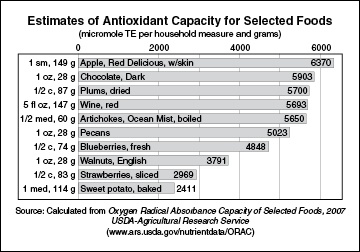
The USDA assessed antioxidant capacity of the most potent antioxidant foods so you may compare the top 10

Some of the antioxidant compounds in foods are easier to digest and absorb than others: for instance, plums have high antioxidant content but did not raise plasma levels when eaten.

As for the wild blueberry, a noticeable increase in blood antioxidant level occurred only after at least a half-cup serving was consume.

On the other hand, the consumption of grapes and kiwis led to sharp spikes in blood antioxidant levels.

Read more about health benefits of foods

Really good foods you must add to your kitchen
Really bad foods you must get rid of
Buckwheat nutritional values
What's in avocadoes? Nutrition and recipes
Olive oil, the good fat
Power foods
Food Sources of Iron
Food Sources of Magnesium
Food Sources of Potassium
Nutrients in yeast

Metabolism: overrated?

Did you know? At a given weight and muscle mass, your metabolism isn't going to go up or down a
whole bunch.
From Brad Pilon
<>Eat Stop Eat

If you are 170 pounds with 150 pounds of lean mass...your resting
metabolism is not going to fluctuate more than the equivalent of
100 or 200 calories worth of calorie burning over a 24 hour period.

I'll admit that it fluctuates throughout the day, depending on your
workouts, eating habits and sleeping habits...but when added up
over 24 hours the total effect of these fluctuations is VERY SMALL,
and it is MINUSCULE compared to the fluctuations in the amount of
food you eat.
Consider this-

It is very easy to overeat by 2,000 calories during a given day.

It is virtually IMPOSSIBLE to raise your resting metabolic rate by
even 1,000 calories above normal...Not with a high protein diet, not
with ephedrine, not by adding ten pounds of muscle, not even by
experimenting with drugs like Clenbuterol.

This begs the question -if the fluctuations that are possible with
metabolic rate are minuscule compared to the fluctuations that
occur with calorie intake, then why does 'metabolism' get all sorts
of attention?

It's because it sounds mystical, magical, and to a certain
extent...down right sexy.

It is great media fodder.

It is a great buzz word.

Put "boost metabolism" in the headline of an article...and it will
get read guaranteed.

What do you think would sell more copies of Cosmo -

"3 secrets to losing weight by boosting your metabolism"

or

"3 secrets to losing weight by eating less"

The truth is, our love affair with our metabolisms is a main cause
of obsessive compulsive eating.

The belief that what you eat can DRASTICALLY change your metabolism
is not only wrong, but it can derail your weight loss efforts.

The bottom line is if you are counting on the foods you eat to burn
your body fat for you, you are going to be very disappointed with
the results.

The most important thing you should learn about eating is not how
foods affect your metabolism, it's learning to appreciate the value
of simply eating less.

Brad Pilon

Fasting days do not slow down your metabolism

by Brad Pilon, author
Eat Stop Eat

I'm back home after a whirlwind trip down to New York City to film
a spot on the Morning Show with Mike and Juliet.

From my experience this was a win. Not a giant win, but a small
significant one.

After all, the point of my appearance on that show wasn't to win
the approval of a dietitian and a medical doctor (It's not like
this was a scientific debate), and I fully expected them to be
skeptical....(after all, they got to hear a 30 second hyped up
montage, me talk for about 1 minute and then were asked to give an
opinion.)

Instead, my plan was to expose a large audience of people to a
style of eating that can help them lose weight, and to help them
understand that this method is incredibly simple and effective.

No supplements, no phases, no stress, no guilt, no unhealthy
obsession with 'eating clean', just a simple way to eat less while
enjoying the foods you eat.

Given the time I had, I think I did a fairly good job.

OK, so now lets get to the good stuff, here is the behind the
scenes info:

First, let's start with the evil dietitian and the mean medical
Doctor - They were actually both super nice, open minded women. I
kid you not! Off the air they were both very likable people.

And, Dr. London is no stranger to the weight room, that lady had
some muscle!

As for their on-air personalities and their concerns about Eat Stop
Eat, well we've all heard them before. "Your metabolism will slow
down and you will lose muscle."...nothing new here.

I knew this was what they were going to say, after all, I thought
the EXACT SAME THING before I went back to school.

And as I said before, my goal wasn't to convince these two people
that I was right and they were wrong...because you simply can't
change a person's way of thinking in only 30 seconds.

But just for the sake of argument and to show that I'm not just
cherry picking one random unnamed, unreferenced study here is
a snapshot of just a few of the papers that I review in Eat Stop Eat
that show that your metabolism does NOT slow down and that you
do NOT lose muscle::

* Carlson MG, Snead WL, Campbell PJ. Fuel and energy metabolism
in fasting humans. Am J Clin Nutr. 1994 Jul;60(1):29-36.

* Halberg N, Henriksen M, Söderhamn N, Stallknecht B, Ploug T,
Schjerling P, Dela F. Effect of intermittent fasting and refeeding
on insulin action in healthy men. J Appl Physiol 2005; 99: 2128-2136

* Jensen MD, Ekberg K, Landau BR. Lipid metabolism during
fasting. Am J Physiol Endocrinol Metab. 2001 Oct;281(4):E789-93.

* Johnstone AM, Faber P, Gibney ER, Elia M, Horgan G, Golden
BE, Stubbs RJ. Effect of an acute fast on energy compensation and
feeding behavior in lean men and women. Int J Obes Relat Metab
Disord. 2002 Dec;26(12):1623-8.

* Klein S, Sakurai Y, Romijn JA, Carroll RM. Progressive
alterations in lipid and glucose metabolism during short-term
fasting in young adult men. Am J Physiol. 1993 Nov;265(5 Pt
1):E801-6.

* Mittendorfer B, Horowitz JF, Klein S. Gender differences in
lipid and glucose kinetics during short-term fasting. Am J Physiol
Endocrinol Metab. 2001 Dec;281(6):E1333-9.

* Samra JS, Clark ML, Humphreys SM, Macdonald IA, Frayn KN.
Regulation of lipid metabolism in adipose tissue during early
starvation. Am J Physiol 1996;271:E541-E546

* Webber J, Macdonald IA. The cardiovascular, metabolic and
hormonal changes accompanying acute starvation in men and women. Br
J Nutr. 1994 Mar;71(3):437-47.

* Zauner C, Schneeweiss B, Kranz A, Madl C, Ratheiser K, Kramer
L, Roth E, Schneider B, Lenz K. Resting energy expenditure in
short-term starvation is increased as a result of an increase in
serum norepinephrine. Am J Clin Nutr. 2000 Jun;71(6):1511-5.

* Gjedsted J, Gormsen LC, Nielsen S, Schmitz O, Djurhuus CB,
Keiding S, Ørskov H, Tønnesen E, Møller N. Effects of a 3-day fast
on regional lipid and glucose metabolism in human skeletal muscle
and adipose tissue. Acta Physiol (Oxf). 2007 Nov;191(3):205-16.
So even if they weren't taking the opposite view just for the
sake of good TV, I should point out that I certainly did not expect
either woman to be completely up to date on the literature in this
field.

I had to go back to school full time, spending almost two years
reviewing papers full-time just to get to the level of
understanding I currently have - and I am nowhere near the world's
leading expert on this topic.

Both these woman run extremely busy personal practices...it simply
wouldn't be fair to think they had time to review all of these
papers before we went on the air. (TV moves fast, I only found out
about this appearance on the Weekend, so I imagine both Kerri and
Dr. London only even heard about Eat Stop Eat on Sunday, maybe 24
hours before the show went live.)

So in the end, despite the fact that I was met with the same old
argument, it was a good experience and I met some great people.

I hope I exposed a lot of people to a style of eating that will
help them lose weight without asking them to become obsessive
compulsive about what they eat or by asking them to spend hundreds
of dollars a month on useless supplements or specialty foods.

The Morning show is run by a group of very nice, very professional
people, and if even one person who saw the show has success with
the Eat Stop Eat lifestyle then it was worth my time.


Sincerely,

Brad Pilon

Author, Eat Stop Eat

Wednesday

How Prebiotics Work

by Tanya Zilberter, PhD
Living in our intestines, are a number of species: some are friendly (e.g., bifidobacterium, eubacterium and lactobacillus); some are hostile (e.g., clostridium, shigella, and veillonella); and some might be deadly.
A prebiotic (not probiotic) is "a non-digestible food ingredient that beneficially affects the host [you] by selectively stimulating the growth and/or the activity of one or a limited number of bacteria in the colon." (Am Clin Nutrit, 2001; 73:406S-409S.)
A probiotic brings external friendly bacteria into the gut's ecosystem, while a prebiotic stimulates the growth the potentially health-promoting microbes-insiders, thus modulating the composition of the natural ecosystem.
Inulin
The best (and, some researchers believe, the only) example of a prebiotic is inulin. Inulin is a "non-digestible oligosaccharide," which simply means that it is a carbohydrate that can not be digested. It can be - and is being - fermented in the lower parts of the intestinal tract. As a result, the friendly intestinal microflora (bifidobacterium) grows better. (How we benefit from that friendly flora is another question and we'll discuss it next time; sign up to be notified.)
Inulin occurs naturally in large quantities in some of the most famous herbs, such as burdock root, dandelion root, elecampane root and chicory root. It is soluble only in hot water, which is why it traditionally been ingested in hot teas. It has a mildly sweet taste and is filling, but, because it is not absorbed, it does not affect blood-sugar levels.
The directly registered effects of the prebiotic inulin are -
  • improved bowel functions mainly due to the increase of fecal bulk;
  • improved bioavailability of minerals that, among other things, may contribute to a reduction in the risk of osteoporosis;
  • improved fat metabolism: there is preliminary evidence of a triglyceride-reducing effect of inulin; and
  • possible reduction of the risk of colon cancer. A "synbiotic" approach combining inulin and bifidobacteria was shown to be more effective than either the probiotic or the prebiotic alone.
Warning! Inulin can trigger an allergic reaction!
Sources:
J Nutr 1999;127(suppl):S1398-401
Annu Rev Nutr 1998;18:117-43
Am J Clin Nutr 2001;73:456S-8S
Am J Clin Nutr 2001; 73:459S -64
Br J Nutr 1999; 82:23-30
Carcinogenesis 1997; 18:1371-4

Monday

How to measure after-meal fullness or before-meal hunger

There are so called satiety scales helping to accurately esstimate how full people become after eating this or that food or meal.

Labelled Magnitude Satiety Scale


1 Greatest imaginable fullness
2 Least imaginable hunger
3 Bursting
4 Stuffed
5 Extremely full
6 Very full
7 Gorged
8 Surfeited
9 Moderately full
10 Extremely sated
11 Very sated
12 Very satisfied
13 Extremely satisfied
14 Extremely content
15 Satisfied
16 Slightly full
17 Very content
18 Moderately sated
19 Moderately satisfied
20 Moderately content
21 Slightly satisfied
22 Slightly sated
23 Slightly content
24 Semi-satisfied

Source: Cardello, A. V., Schutz, H. G., Lesher, L. L., & Merrill, E. (2005). Development and
testing of a labeled magnitude scale of perceived satiety. Appetite, 44(1),
1–13.

And here's are a couple of much simpler scale including 10 points for both satiety and hunger:

Hunger and Satiety Scale

0 - Ravenously hungry.
1 - Feel like ordering everything on the menu.
2 - Preoccupied with hunger, everything on the
menu looks good.
3 - Feel hungry and the urge to eat is strong.
4 - Feel a little hungry. Can wait to eat.
5 - Neutral, not hungry, not full.
6 - Sense food in your belly, could eat more.
7 - Hunger is gone. If you stop here, you may
not feel hungry for 3 to 4 hours.
8 - Not uncomfortable, definitely full belly.
9 - Moving into uncomfortable.
10 - Very uncomfortable, maybe even painful.

Source: Rockies and Univ. of Wyoming Coop. Extension Service, Family & Consumer Sciences.

Hunger/Satiety Scale
Developed by University of Illinois at Urbana - Champaign, 1998

1 = Famished, starving
2 = Headache, weak, cranky, low energy
3 = Want to eat now, stomach growls and feels empty
4 = Hungry - but could wait to eat, starting to feel empty but not there yet
5 = Not hungry, not full
6 = Feeling satisfied, stomach feels full and comfortable
7 = Feeling full, definitely don’t need more food
8 = Uncomfortably full
9 = Stuffed, very uncomfortable
10 = Bursting, painfully full

What fulness after a meal depends on?

One of the direction is studies into the so called satiety signals, which can decrease in the size of at meal. The most usual suspect was glucose: when its level drops in the time course after the previous meal, this drop is 'felt' by sensor cells in the brain resulting in sensations of hunger. (Ann NY Acad Sci 63: 14–42, 1955.)

Another candidate to satiety signals is one of ketone bodies (produced in the liver from body fat during fasting,even the overnight one,exercise, stress, or on a low carb diets. This ketone body is called beta-hydroxybutyrate and it reduced food intake after intra-venuos injection before meal. (Nutrition. 1999;15:704-714).

The meal used consisted of 250 g cooked vegetables, 35 g cheese, 50 g croutons and 25 g olive oil but for one group of volunteers, the meal was vegetable pieces in the broth they cooked in while for another group, the vegetables were homogenized, also with the broth, in a blender. The meal was significantly more satiating when in the homogenized form than when eaten in a solid–liquid state. It corresponded to longer time the food remained in the stomach and with higher levels of the "satiety hormone" cholecystokinin. (British Journal of Nutrition (1998), 80, 521–527)

Protein has been observed to increase satiety to a greater extent than carbohydrate and fat and can therefore reduce energy intake. Sleeping metabolic rate was significantly higher on a high-protein diet than the same-calorie, lower protein diet. Most importantly, the high protein diet resulted in increased use of body fat to cover the increased metabolic rate. Hunger sensation was higher especially during the evening and satiety was the higher the higher protein content of the diet. (American Journal of Clinical Nutrition, Vol. 83, No. 1, 89-94, 2006)

Glycaemic and insulin responses to carbohydrate foods are inversely proportional to the CCK response and satiety (Appetite. 1992 Apr; 18(2): 129-41)

Sunday

Whole grain: hulled millet

Hulled millet, nutrition facts

1 cup serving, raw grain:
GramsCalories%-Cals
Calories
756


Fat
8.4
71
9
%
Saturated
1.4
12
2
%
Polyunsaturated
4.3
36
5
%
Monounsaturated
1.5
13
2
%
Carbohydrate
145.7
600
79
%
Dietary Fiber
17.0


Protein
22.0
85
11
%
Alcohol
0.0
0
0
%

Vitamins and minerals, % RDA

Vitamin A
0
%
Calcium
2
%
Vitamin D
0
%
Thiamin
56
%
Niacin
47
%
Vitamin B6
38
%
Phosphorus
57
%
Selenium
8
%
Vitamin C
0
%
Iron
33
%
Vitamin E
0
%
Riboflavin
34
%
Vitamin B12
0
%
Manganese
163
%
Copper
75
%
Magnesium
57
%
Zinc
22
%

Because the hull is very hard, millet is usually hulled (or pearled) before it is used for cooking. After hours of boiling it will still be hard and the hulls remain entirely indigestible.

However, the hulled millet is still a whole grain because the most valuable part of the grain, germ, stays intact through this process so hulled millet keeps its nutritional properties. In hulled millet, the amount of fibers per serving is still high (17 g per a cap)

Millet is gluten-free, has a very low Gglycemic index, does not support the growth of candida responsible for the yeast infection but feed the friendly bacteria in the intestine, which makes this grain a prebiotic.

Thursday

PROTEIN SPARING MODIFIED FAST DIET


This approach has to be reserved to patients with an severe obesity (overweight above 70 %) without metabolic disorders and for whom a fast and significant weight loss is advisable.

The aim is to achieve a fast weight loss in the shortest period of time. Protein sparing modified fast diet requires a close clinical and metabolic monitoring, in particular for the risk of cardiac arrhythmia and severe ketosis.

Protein sparing modified fast diet allows only meat, fish and vegetables. It provides a caloric intake equal to or less than 800 kcal/die; protein intake ranges from 1.5 to 2.5 g/kg/die (the percentage is from 50 to 65 %), remaining calories come from lipids (40%) and carbohydrates from vegetable sources (10%).

During the treatment, daily supplementations must be given: calcium (800 mg), KCl (25 mEq/l), vitamins and micronutrients, non-caloric drinks (2 litres).

Protein sparing modified fast diet produces considerable weight loss up to 1 kg per week and this can induce adolescent to associate weight loss to drastic diet and to continue an unbalanced diet for a long period of time.

There is not demonstration that in long-term management this diet gives better results than hypocaloric balanced diet.


ORIGINAL RESEARCH COMMUNICATIONS

A comparison of two very-low-calorie diets: protein sparing modified fast versus protein-formula-liquid diet

TA Wadden, AJ Stunkard, KD Brownell and SC Day

This study investigated the acceptability of two very-low-calorie diets in 16 moderately overweight persons participating in a weight reduction program. Subjects were prescribed a 1000-1200 kcal balanced diet the first month and asked to complete appetite and mood scales on a weekly basis. They were then randomly assigned to either a protein sparing modified fast or a protein-formula-liquid diet, each of which provided about 400 kcal daily. Analysis of the appetite data showed that protein sparing modified fast subjects reported significantly less hunger and preoccupation with eating than did liquid diet subjects during 2 of the 4 weeks on a very-low-calorie diet. Subjects in both conditions reported significant reductions in anxiety. Results are discussed in terms of possible advantages of protein sparing modified fast

American Journal of Clinical Nutrition, Vol 41, 533-539, Copyright � 1985

Protein-sparing modified fast in the treatment of severe obesity: weight loss and nitrogen balance data.

Contaldo F, Di Biase G, Scalfi L, Presta E, Mancini M.

Compared: total fasting with protein-sparing modified fast
  • Group 1 - total fasting;
  • Group 2 - protein-sparing modified fast (80 kcal, 17 g protein, traces of fat and carbohydrate);
  • Group 3 - protein-sparing modified fast (180 kcal, 40 g protein, 2 g fat, traces carbohydrate)
  • Group IV - protein-sparing modified fast (80 kcal during the 1st and 2nd week and 180 kcal during the 3rd and 4th week).

RESULTS

In in groups 1, 2 and 4 average weight loss was 11 kg. It was lower,average 8 kg, in group 3.

These observations suggest a new approach to the treatment of severe obesity by protein-sparing modified fast and show that is is possible to further reduce the early catabolic phase which commonly arises during this type of therapy.

International Journal of Obesity. 1980;4(3):189-96.

Antioxidants, vitamins, minerals: what's missing?

by Lee Euler

Dear Friend,

If you take antioxidants, vitamins, and minerals you're only getting it half-right. A new class of nutrients is just as important – maybe MORE important.

In five or ten years most people will be taking these nutrients right along with vitamins and minerals. Yet few are taking them now.

These nutrients do not exist in most of the foods sold in health food stores, whether organic or not. Almost any cooking or processing destroys these highly complex molecules.

What's more, all the antioxidants and other supplements you take are half as effective – or worse – if you don't get THIS nutrient either in your food or in supplement form.
And I can almost guarantee you're not getting it

So you can look at this letter as a privileged glimpse into the future. By reading this you're putting yourself at the cutting edge of a nutritional revolution. There's a huge potential for healing many mystery health problems that have stumped doctors for decades.

Heads up for cancer patients!
"The missing nutrient" beats chemotherapy 100-to-one

A man with kidney cancer, given 50 days to live, was alive and well 15 years later, thanks to this supplement.A woman with metastatic breast cancer – a "death sentence" – was alive and well 16 years later – thanks to the missing ingredient.

These incredible results are a matter of record, published in medical journals by Dr. Nicholas J. Gonzalez, an M.D. in New York City.

And how about pancreatic cancer patients who were told they had "no hope"? This natural nutrient outdid chemotherapy by better than a hundred to one!

When Dr. Gonzalez began his study of 11 "hopeless" patients, an NIH "expert" told him he'd be lucky if three of them lived more than a year. Cancer of the pancreas is usually fatal – and fast.

So what happened? NINE of the patients in the study lived more than a year and four of them lived more than three years! Meanwhile, out of 126 patients on chemotherapy, NOT EVEN ONE survived for two years.

A hidden nutritional deficiency
is linked to a dozen or more diseases

No one else will tell you this, but the soaring cancer rate in our society may be due in part to a specific nutritional deficiency – the lack of this "missing ingredient" in our diets. A hundred years ago, most people were getting enough of this nutrient, but not any more.

The lack of this vital nutrient leaves us wide open not only to cancer, but to heart disease, arthritis, allergies, and all kinds of digestive problems. It's even linked to autism, lupus and multiple sclerosis.

You can experience a huge improvement in your health – often overnight – when you add this nutrient to your diet, either in supplement form OR by eating the right foods.

You'll discover WHAT this nutrient is, WHY it's not in our food anymore (although it was a hundred years ago), HOW the deficiency devastates your health, and exactly WHAT you can do about it. It's all in a new Special Report I've written called The Missing Ingredient for Good Health. Take heed and you might experience…

Dramatic improvement in heart health and circulation:
This "Roto-Rooter" supplement
cleans out the gunk in your arteries

Meet "the plaque-eater!"

This supplement does in weeks what other treatments take months to achieve, according to Dr. J. Valls-Serra of the University of Barcelona. More than nine out of ten patients with blood clot disorders got totally well.

Blood clots are the prime cause of heart attacks and strokes – and doctors put millions of people on medications like coumadin and warfarin to thin their blood. Most of these people would get better, faster, if they just added "the Missing Ingredient" to their diet or supplements.

In my report, The Missing Ingredient for Good Health I'll show you study after study that confirms the heart and circulation benefits you can experience by taking this supplement. Very few American doctors know about these studies because they were published in German and have never been translated.

That means your doctor – and you – are missing an important new discovery about the so-called diseases of aging.

Your danger of cancer, heart disease, stroke
and arthritis go up as you age –
But it's not because you're getting older

You can help reverse the so-called "diseases of aging" by correcting a nutritional deficiency. More than nine out of ten patients with inflamed blood vessels improve when they take this nutrient, and most of them get totally well.

And what's the most common complaint as we get older? It's probably pain. Many "experts" call the most common kind of arthritis – osteoarthritis – a "wear and tear" disease. According to them, our joints wear out and we just have to live with it.

But maybe not! Just consider…

Pain goes away without drugs —
Study after study shows the "Missing Ingredient"
is more powerful than NSAIDs

In study after study, patients find the missing nutrient is more powerful than prescription pain relievers. Not only do osteoarthritis patients get better, but in a group of 1,004 rheumatoid arthritis patients, nine out of ten got better when they took the "Missing Ingredient." As you may know, rheumatoid arthritis is far more serious than osteoarthritis – and all but incurable. Or that's what they tell you.

Don't believe it. There IS hope.

Young people with pain can benefit, too. Controlled scientific studies show that injured athletes heal and get back on the field in less than half the time of those on a placebo. The reason is that the missing nutrient doesn't just mask pain, it heals the injury – the real, underlying cause.

Most of these pain studies were done in Germany. In fact, this nutrient is the second most popular pain reliever in Germany after aspirin. German doctors are well aware of the benefits of this nutrient. Yet most American doctors – even alternative doctors – don't know about it. And most Americans have never heard of it.

Eventually the word will get out. But why should you wait?

The almost-unknown power of this nutrient might take your health to a whole new level. Within days or weeks – sometimes the first day – you can see miraculous relief from medical problems that have troubled you for years.

One woman reports she now has four extra hours a day – hours she used to spend sleeping or too fatigued and mind-fogged to do anything.

MORE BENEFITS:
Say good-bye to indigestion, bloating, IBS, gas,
diarrhea, constipation and cramps

Digest your food right for the first time in your life. The missing nutrient treats the real, underlying problem. It often cures suffering victims once and for all.

Many patients report instant, miraculous relief. Food allergies go away for good and you can eat anything! A delighted heartburn victim was able to cancel surgery, and a baby's colic vanished in one day.

I can tell you it's true from personal experience. I totally cured a spastic colon that troubled me for more than twenty years.

Proven:
Nine out of ten autism cases get better!
Helps other behavioral and learning disorders, too

In my Special Report, The Missing Ingredient, you'll see how 91 percent of a group of 260 autistic kids got better. For more than a third of the children the improvement was "very great or impressive."

"We enjoyed a regular meal at a family restaurant," emailed one parent. "No stress, no reactions. We are so happy."

A natural wonder we've stripped out of our food

Our own bodies make these "missing nutrients." What's more, they exist in every type of food – BUT ONLY IF THE FOOD HASN'T BEEN COOKED.

And that's the catch. Almost everything we eat is cooked. Even most health foods are cooked. All milk products and store-bought juices are pasteurized. That means they're heated until these nutrients are destroyed. Food companies process even frozen foods until this nutrient is mostly gone.

We've almost totally eliminated these essential-to-life nutrients from our diets. As a result, the health of millions of Americans is going downhill faster than an Olympic skier.

Wait till you see what happens to animals deprived of this type of nutrient! It's not pretty. They quickly develop what we call – wrongly – the diseases of aging. Their offspring are even sicker, and the third generation is sterile and half-dead. The Special Report provides the details – the frightening consequences you risk when this nutrient is missing from your diet.

You'll get complete details on every single fact and claim in this letter when you purchase my new Special Report, The Missing Ingredient for Good Health.

As you'll discover, you can take all the vitamins, minerals, herbal remedies and supplements you want and you still won't get as well as you should. It's all because you're missing this nutrient.

In the report, you'll see case after case where patients took all the supplements from A to zinc and still suffered pain, heart disease, digestive problems and even cancer. When they added the "Missing Ingredient" their symptoms got dramatically better and even completely disappeared.

Lifelong migraines, stomach upsets, pain and fatigue often go away almost instantly for people who discover they lack this vital nutrient — and then do something about it.

How could alternative doctors overlook this vital nutrient?

Alternative doctors do recommend "the Missing Ingredient" sometimes, for some health problems. But few alternative doctors put these nutrients on a par with antioxidants, vitamins, minerals and other phytochemicals (nutrients found in plants).


Most alternative doctors would tell you "the Missing Ingredient" is a second or third level supplement, something you take "in addition to" the "important" nutrients.

That's dead wrong.

And within a few years, they'll change their minds. You'll see – but you'll be there before them. In a few years everyone will supplement with the Missing Ingredient. It's far more powerful than most doctors know, as you can see from the studies and patients I've cited. Those examples are just the tip of iceberg.

By the time you finish my Special Report, The Missing Ingredient for Good Health, you'll be convinced beyond doubt of the overwhelming importance of these nutrients.

THINK OF IT: cancer, heart disease, pain…even autism, for crying out loud…are all linked to our poor diets.

Certain select doctors DO know about the Missing Ingredient

I stumbled across the Missing Ingredient only because I've spent the last several years researching and writing about alternative cancer treatments.

My name is Lee Euler. I'm the publisher of a number of Special Reports on alternative cancer treatments, including Natural Cancer Remedies that Work, Cancer Defeated: How Rich and Poor Alike Get Well in Foreign Clinics, and The Oxygen Miracle.

I've been writing and publishing alternative health information for more than 15 years, and I thought I'd seen it all. I was wrong. I was shocked to find out that something this important was overlooked by almost everybody.

It just goes to show how much we have to learn about all the nutrients we need for good health. As I found out, only a select few doctors know about this important discovery…

The only people on earth who know this information

Alternative cancer doctors are just about the one group of people on earth who know the true power of the Missing Ingredient. They've achieved remarkable results, but most alternative doctors stay miles away from cancer. They don't know the latest strides being made in cancer treatment.

In America, an alternative doctor can lose his license for treating cancer patients. Few doctors take the risk. It's too bad, because that means they've missed this incredible breakthrough.

Their tragic oversight could cost you your good health and your life, because the Missing Ingredient is effective not only against cancer but also heart disease, pain, arthritis, digestive problems, allergies, MS, lupus and more!

In other words, intimidation by America's cancer police has caused most alternative doctors – of all people – to miss a nutritional revolution!

Raw, fresh foods pack a punch you won't believe

Cancer doctors have discovered that the food the patient eats is critical to successful cancer treatment. What's more, the diets that cancer doctors recommend have one big ingredient in common. It's a nutrient that's NOT found in cooked food – ONLY in raw food.

But it's not my intention to nag you about getting four servings of vegetables or five servings of fruit or whatever. That's wonderful to do, but you can get this nutrient in a pill or capsule.

You probably don't, because doctors who DON'T treat cancer know very little about it and say even less. That's a shame because…

The benefits of this type of nutrient go way beyond cancer

Actually, you can find the most amazing benefits in autistic children when they start to take the Missing Ingredient. The results – detailed in my Special Report The Missing Ingredient for Good Health – will make your eyes pop right out of your head.

The proof is clear and undeniable. You'll see. And if you know a family with an autistic child, you'll give them this Special Report and beg them to read it. As far as that goes, if you know someone with cancer, heart disease, fatigue or pain you'll do the same thing!

You'll want to tell everyone you know the good news!

Cancer doctors use the Missing Ingredient as one of many therapies, but with the autistic children, the incredible improvement was the result of this nutrient and ONLY this nutrient. And the healing that took place was so dramatic no one can deny it.

What's more, the group of children involved was large – 260 kids. And the mother who collected the data was a trained scientist who was unusually careful and rigorous.

In other words, the jury is in and the verdict has been rendered: the Missing Ingredient can change your life and save your life.

Information available nowhere else

Let me say this again: I don't sell these supplements. I don't make a dime off the pills if the Special Report inspires you to change your life and start taking them. My only business is spreading this important information.

Only two or three books have been published about this nutrient. They went almost unnoticed. And as I said, most alternative doctors have missed this critical news.

That means my Special Report, The Missing Ingredient for Good Health, is the first publication to pull all facts and proof together into one place in a way that will leave you in no doubt that your current diet and supplements aren't enough.

You could search in vain through hundreds of back issues of America's most popular health newsletters to find the breakthroughs I report in The Missing Ingredient for Good Health. You'll be so excited…

You'll rush to the nearest supplement store to get started…

…because you're missing a vital nutrient that no one can do without if they want to enjoy full health and prevent diseases like cancer, heart disease, stroke, arthritis, fatigue, and more.

The success achieved with this supplement in beating cancer will be enough to make you put down the report after Chapter Two and rush to a health food store to buy this type of nutrient. You'll open the bottle in the car and take your first dose before you get home. What's more…

This is a perfectly safe food

Even in alternative medicine, it's rare for experts to be able to say a remedy is perfectly safe. But I can say it now: the "Missing Ingredient" is safe – totally. These natural nutrients are found in almost every type of food PLUS your own body makes them itself (but our bodies make less and less as we get older). Even the FDA classifies them as a food.

It's almost inconceivable you could harm yourself by taking these nutrients in pills or capsules. In animal experiments the little critters have been fed the equivalent (for a human) of 30 pounds of this stuff with no problems at all.

The revolution has just begun,
and we're learning more every day

How is it possible experts have overlooked the value of The Missing Ingredient for so long? As you just saw, one reason is that most alternative doctors stay away from cancer.

What's more, the whole subject of nutrition is still in its infancy.

Life Extension, the breakthrough book about antioxidants, was published only 25 years ago. This is new stuff. Almost every year, researchers find a new chemical in fruits, vegetables, nuts or seeds that can improve health and save lives. If 1492 was the year Columbus stumbled on America, then this is roughly the year 1530 where nutrition is concerned. Who knows where we'll be in another ten years?

Let me tell you a story…

Three hundred years ago no one knew what a vitamin was. If you'd said the word "antioxidant" people would have looked at you as if you had two heads.

That was back in the age of sail, and thousands of sailors got very sick from a mystery disease if they spent long months at sea. One of the symptoms was that all their teeth would fall out! Bad news!

The disease was called scurvy. An English doctor was alert enough to notice that scurvy disappeared totally – and fast! – when the sailors ate fresh citrus fruit. Eventually the Royal Navy required every ship to carry a supply of oranges, lemons or limes to keep the sailors healthy.

That's why the English are called "Limeys" to this day.

Now we know that vitamin C was the ingredient in citrus fruit that cured scurvy. Scurvy is what's called a deficiency disease. It's caused by the lack of a nutrient our bodies MUST have. If you provide the missing nutrient, you cure the disease.

It was a long, long time before scientists discovered vitamins and antioxidants. They just knew there was something in citrus fruit that prevents scurvy and cures the disease if you already have it.

Nutrition CAN cure a whole bunch of diseases

We've come a long way since vitamin C saved the first Limeys. Yet we still haven't connected all the dots. With antioxidants and definitely with the Missing Ingredient that you'll discover in the Special Report, there's still a lot to learn.

Alternative doctors have to do most of the work while the medical establishment persecutes them. The health authorities even send out police with handcuffs to stop alternative doctors from practicing.

Conventional medicine is NOT interested in finding nutritional reasons behind the epidemic of cancer, heart disease, allergies, learning disorders, and autoimmune diseases like MS and arthritis. Far from it. These prescription drug-peddlers try to prove nutrition does NOT cure these diseases. Boy, are they wrong…

When you order your personal copy of the Special Report, you're going to see that the Missing Ingredient often achieves results just as dramatic as those achieved by feeding limes to scurvy victims. I'm talking about overnight cures.

The class of nutrients you'll discover in the Special Report can achieve miracle "magic bullet" results. But you shouldn't look at them that way. You should look at these nutrients as one of the essentials you need in a lifetime of eating right, along with antioxidants, minerals. . .and things we haven't discovered yet.

Raw, unprocessed food achieves miracle cures –
And you can reap the same benefits through supplements

In the Special Report The Missing Ingredient for Good Health, you'll see how this new, overlooked nutrient works hand in hand with antioxidants, minerals and other plant chemicals to fight the degenerative "diseases of old age." These diseases are seldom found in people who eat right.

I'm telling you, alternative cancer doctors have cured many people just by feeding them a diet of raw, uncooked, organic fruits, grains and vegetables. Other cancer doctors achieve the same results with the supplements. My colleagues and I have toured the clinics, talked to the patients, and witnessed the results.

And when I say cured, I mean "cured," not just "delayed death." My associates and I have met some of these lucky patients or received their emails thanking us for the cancer information we publish in Special Reports like Cancer Defeated and Natural Cancer Remedies that Work.

Now, let's be clear: alternative cancer doctors can't cure everyone. When it comes to cancer, there's no 100% sure thing. For one thing, many of the people who come to alternative cancer doctors are too far gone. They've waited too long.

But alternative cancer doctors do CURE a great many of these people and prolong the lives of others far more effectively than conventional cancer treatments such as chemotherapy.

And this remarkable success is partly due to the Missing Ingredient, which you can start taking today as either uncooked food or in the form of supplements available in any health food store.

And that's a fact.

You'll experience a "Eureka!" moment
that can change your life

After reading the report, you'll understand for the first time how good nutrition works. You'll see WHY more of us are coming down with chronic diseases every year and how EASY it is to turn your health around with good sense – and the new information in The Missing Ingredient for Good Health.

You're protected by a 100% guarantee

You can order The Missing Ingredient for Good Health as a digital download. And, you have a full 60 days to read it, use it, and think it over. If you're not completely satisfied with the Special Report, just let us know and one of our friendly customer service people will give you a FULL REFUND. No questions asked, no quibbling. Every penny of your money back.

AND YOU DON'T HAVE TO RETURN THE REPORT. KEEP IT.

Well, as a practical matter you can't return a digital download. No matter. You can still get every penny back.

I'm not worried, because very few of our readers ask for a refund. Instead, we get letters thanking us for the life-changing information we've provided.

You risk nothing whatsoever

There's no reason to pass by an offer like this. The information is vitally important. Each and every one of us needs this nutrient. We're not getting it. And frankly, this deficiency is making a lot of people very sick.

You owe it to yourself to find out what's what. The Special Report The Missing Ingredient for Good Health will set you on your way.

With kindest regards

Lee Euler
Writer and Publisher

P.S. I take "the missing ingredient" myself in supplement form, and the changes in my life have been remarkable.
Tuesday

Nutrients for Better Learning

by Tanya Zilberter, PhD


Out of all nutrients known for their effects on brain functions, two groups are assumed being of particular importance for the process of learning therefore being of even more importance for children with learning disabilities. This is what they are and why.

The process of learning is believed to rely on mechanisms providing contacts between brain cells called, as you know, neurons. These contacts take place in highly specialised tiny places where two neurons physically contact each other called synapses. One of the neurons initiates the contact by releasing a chemical substance, called neurotransmitter, into the narrow cleft separating pre-synapse from post-synapse.

As soon as the neuron-recipient feels this substance, it gets all excited and became electrically active. The more often the contact the easier the recipient gets excited. Under one important condition: if there's enough of the substance-neurotransmitter. More synapses involved mean a higher probability of newly formed communication pathways - "learned" ones. There are enzymes and their helpers co-enzymes that work facilitating the production of neurotransmitters. Many vitamins are involved in enzymes' work. The good example of co-enzymes is the well-known supplement co-enzyme Q10.

Another way to help the process of learning is to supply the brain with neuronal metabolites that promote neuronal growth and activity and enrich the brain architecture.

This is the list of nutrients, which were under investigation whether they work for children with learning disabilities (Alternative Therapies in Health and Medicine, 2000, 6(3): 85-91):

1. Magnesium Chelate 100 mg (at bedtime since it causes drowsiness)
2. Pure Vitamin C 100 mg (bioflavanoids were excluded due to their adverse effects on learning disabilities)
3. Vitamin B1 Thiamine 50 mg
4. Vitamin B3 Niacinamide 50 mg
5. Vitamin B6 Pyridoxine 100 mg
6. Vitamin B12 500 mcg
7. Folic Acid 400 mcg
8. Manganese Chelate 20 mg
9. Zinc Chelate22.5 mg
10. L-tyrosine 500 mg
11. L-glutamine 500 mg
12. Linoleic Acid as evening primrose oil 500 mg
13. Co-enzyme Q10 10 mg

These nutrients were tested on a group of 19 children with learning disabilities for 4 years resulting in dramatic improvement in behavior and academic grades. All the participating children were able to join the mainstream school classes. Those who discontinued the program remained in normal range of school performance for almost one year, however their grades were gradually decreasing. Those who stayed on the program, continued improving their grades during this year so that in the end of the year 4, the difference in overage grades became very significant: 94.6 in those remaining versus 79 in those who discontinued.

Out of the nutrients on the list, the most prominent effect had magesium, vitamins B1 and B6, Zn, and folic acid, followed by vitamin C, L-glutamine, and primrose oil. Manganese was found to have mild adverse effects.

Friday

Facts about carnitine

Surprising facts about carnitine revealed...

With many of the larger companies planning to stop selling supplements containing ephedrine and caffeine, the search is on for alternative ingredients to use in weight loss products. One of the most popular is a supplement known as carnitine.

It's often difficult to find independent facts about carnitine, mainly because many magazines and web sites are owned by companies that sell it. On the other hand, some writers tend to gloss over any positive facts about carnitine, claiming that exercise and a "balanced" diet is all you need to lose weight. As with many things, the reality lies somewhere in the middle.

Although most people are interested in carnitine because of its effect on weight loss, it has been studied for many other purposes. One of the little known facts about carnitine is that acetyl-L-carnitine (which is slightly different from L-carnitine) is reported to have benefits for people suffering from Alzheimer's disease [12].

Facts about carnitine

First isolated from muscle tissue in 1905, L-carnitine became popular as a weight loss supplement in the 1980's. Theoretically, increasing the amount of carnitine in your body increases the use of fat as a fuel source, making weight loss faster and easier.

Because carnitine appeared to act as a vitamin, it was originally called vitamin BT. Scientists discovered later that your body uses two amino acids — lysine and methionine — together with vitamin C, iron, vitamin B6 and niacin, to make carnitine. Although it's sometimes called an amino acid, L-carnitine is probably best described as a vitamin-like nutrient.

Your body produces carnitine in the liver and kidneys. It then gets stored in tissues that use fat as a source of energy, such as skeletal and heart muscle. Carnitine can also be found in foods such as meat or dairy products. In total, your body stores 20-25 grams of L-carnitine — usually a mixture of both sources.

Carnitine isn't really considered an essential nutrient because your body can make it by itself. Under certain conditions, however, the demand for carnitine may exceed the ability of your body to make it. This has led some to classify carnitine as conditionally essential.

Weight loss

A fatty acid contains many carbon atoms joined together. When fatty acids are burned for energy, these carbon atoms (together with their associated hydrogen atoms) are removed two at a time. Once the component atoms of the fatty acid have been broken from each other and combined with oxygen to form carbon dioxide and water, it is said to have been oxidized. Essentially, the terms "fat oxidation" and "fat burning" both mean the same thing.

Carnitine plays a vital role in the oxidation of fat, which is the main reason for the interest in carnitine supplementation as an aid to weight loss..

The rest of this report is available in the Members-Only Area. Subscribe to the Members-Only Area and you'll enjoy immediate access to a "secret vault" of expert knowledge and university-tested tips and tricks you can use to shed stubborn fat once and for all... get bigger biceps, broader shoulders, a bigger bench press... or strip away the fat from your belly to reveal a flat and attractive stomach. Click here now to join.

If you're a member, you can click here to continue reading.

CLA supplements

CLA supplements: Side effects the supplement companies don't tell you about...

Lately, conjugated linoleic acid (CLA) supplements have been attracting the attention of both scientists and the public alike. Sold as a weight loss supplement, CLA is supposed to be free of the side effects common with other fat burners containing ephedrine and caffeine.

Can CLA supplements really help to speed up fat loss? Are there specific brands (such as Tonalin CLA) that are more effective than others? And are there any CLA side effects you're not being told about?

Much of the scientific interest in CLA supplements started in 1988 when...

The rest of this report is available in the Members-Only Area. Subscribe to the Members-Only Area and you'll enjoy immediate access to a "secret vault" of expert knowledge and university-tested tips and tricks you can use to shed stubborn fat once and for all... get bigger biceps, broader shoulders, a bigger bench press... or strip away the fat from your belly to reveal a flat and attractive stomach. Click here now to join.

If you're a member, you can click here to continue reading.

Saturday

Very Low Calorie Diet. Dr. Shatalova and Current Discoveries

Calorie Theories, Longevity, and Natural Health (look inside the book)

Table of Contents

Calorie Theories            1
Calorie counting: The Many Types of Calories        1  
The Calorie Games        4
Is this a correct answer?    5
Is there scientific evidence?        5
Study #2 Harvard School of Public Health.    7
What do we count when we think we count calories?    8
The "Astronauts' Diet"            11
2006, Dr Shatalova celebrates her 90th anniversary    13
Super Marathon        15
The "Human Species' Nutrition. How About Physical Laws?    16
Alpine Hikers' Success Stories    19
Very Low Calorie Diets and Diseases    21
What is Energy?    23
Longevity and Optimal Health    25
Is This Only for a Chosen Few?    28
The Homo Naturalis    28
What Body Weight is Natural?    30
An Interview with Galina Shatalova    31
Dr. Shatalova’s Health System            37
The Rules    37
How Many Meals a Day?    38
Cleansing Procedures.    38
The Cooking Technique    40
The Meal Rules    40
RECIPES            41
Kelp Sauce    41
Early spring wild greens salad    42
Sesame Sauce    43
Soy bean pate    43
Green Sauce    44
POTATO RECIPES        45
Why potato?        45
New potatoes with wild spring greens    45
Potato Galushki    46
Potato Khachani    47
Potatoes and carrots    48
Potatoes and mushrooms    48
Pokhlebkas        49
Basic Pokhlebka    50
Russian Nettle Soup    52
Russian Turnip soup    53
Russian Onion soup    54
The cabbage soup diet        54
Full Schi    55
Appendix            57
Very Low Calorie Effect on Health and Life Span        57
Low Calorie versus Low Carb    59
Can Adults Benefit from Calorie Restriction?    60
Is VLCD stressful?    61
So, How Does it Work?    62
Fasting.        63
Fat Burning Basics Fasting and Ketones.    63
Ketone bodies    64
Women are different    64
Blood flow to fat tissue    65
Glucose and insulin    65
Hormones    65
Cold weather and heat production    66
Fat burning does occur at an increased rate during fasting.    66
The obese burn fat during fasts.    67
Lipolysis during fasting decreases as we age.    68
How I fast        69
If you committed a longer fast    71
RECOVERY    72
Calorie restriction update            73
Calorie restriction or overeating prevention?        73
The Satiety Index        77
Satiety Index Table.    78
The Body-mind            80           
Relaxation Response        80
How to do the relaxation response exercise:    82
Progressive Relaxation Exercise    82
Breathing Meditation    84
Footnotes for the references included in the text under numbers    87

Order from the publisher: https://www.createspace.com/3441354 

Wednesday

McDonald's Nutrition

McDonald's USA Nutrition Facts for Popular Menu Items, adapted from mcdonalds.com
Nutrition Facts % Daily Value
Sandwiches
Hamburger 3.5 oz (100 g) 250 80 9 13 3.5 16 0.5 25 9 520 22 31 10 2 6 6 12 0 2 10 15
Cheeseburger 4 oz (114 g) 300 110 12 19 6 28 0.5 40 13 750 31 33 11 2 7 6 15 6 2 20 15
Double Cheeseburger 5.8 oz (165 g) 440 210 23 35 11 54 1.5 80 26 1150 48 34 11 2 8 7 25 10 2 25 20
Quarter Pounder®+ 6 oz (169 g) 410 170 19 29 7 37 1 65 22 730 30 37 12 2 10 8 24 2 4 15 20
Quarter Pounder® with Cheese+ 7 oz (198 g) 510 230 26 40 12 61 1.5 90 31 1190 50 40 13 3 11 9 29 10 4 30 25
Double Quarter Pounder® with Cheese++ 9.8 oz (279 g) 740 380 42 65 19 96 2.5 155 52 1380 57 40 13 3 11 9 48 10 4 30 35
Big Mac® 7.5 oz (214 g) 540 260 29 45 10 51 1.5 75 25 1040 43 45 15 3 13 9 25 6 2 25 25
Big N' Tasty® 7.2 oz (206 g) 460 220 24 37 8 42 1.5 70 23 720 30 37 12 3 11 8 24 6 8 15 25
Big N' Tasty® with Cheese 7.7 oz (220 g) 510 250 28 43 11 54 1.5 85 28 960 40 38 13 3 12 8 27 10 8 20 25
Filet-O-Fish® 5 oz (142 g) 380 170 18 28 3.5 19 0 40 14 640 27 38 13 2 7 5 15 2 0 15 10
McChicken ® 5 oz (143 g) 360 150 16 25 3 15 0 35 11 830 34 40 13 2 7 5 14 0 2 10 15
McRib ®† 7.4 oz (209 g) 500 240 26 40 10 48 0 70 23 980 41 44 15 3 10 11 22 2 2 15 20
Premium Grilled Chicken Classic Sandwich 8 oz (226 g) 420 90 10 15 2 10 0 70 23 1190 50 51 17 3 13 11 32 4 10 8 20
Premium Crispy Chicken Classic Sandwich 8.1 oz (230 g) 530 180 20 31 3.5 17 0 50 17 1150 48 59 20 3 13 12 28 4 8 8 20
Premium Grilled Chicken Club Sandwich 8.8 oz (250 g) 530 160 17 27 6 29 0 90 31 1470 61 52 17 4 14 12 40 8 10 20 20
Premium Crispy Chicken Club Sandwich 9 oz (254 g) 630 250 28 43 7 36 0 75 25 1420 59 60 20 4 14 13 36 8 8 20 20
Premium Grilled Chicken Ranch BLT Sandwich 8.3 oz (237 g) 470 110 12 19 3 15 0 80 26 1500 63 53 18 3 14 13 36 4 10 10 20
Premium Crispy Chicken Ranch BLT Sandwich 8.5 oz (240 g) 580 200 23 35 4.5 22 0 60 21 1460 61 61 20 3 14 14 32 4 8 8 20
Southern Style Crispy Chicken Sandwich 5.7 oz (164 g) 400 150 17 26 3 14 0 45 16 1030 43 39 13 1 5 6 24 2 2 10 10
Ranch Snack Wrap® (Crispy) 4.1 oz (117 g) 340 150 17 26 4.5 23 0 30 10 810 34 33 11 1 4 2 14 2 0 10 10
Ranch Snack Wrap® (Grilled) 4.3 oz (122 g) 270 90 10 16 4 19 0 45 15 830 35 26 9 1 4 2 18 2 2 10 10
Honey Mustard Snack Wrap® (Crispy) 4.2 oz (118 g) 330 140 16 24 4.5 22 0 30 10 780 33 34 11 1 4 4 14 2 0 10 10
Honey Mustard Snack Wrap® (Grilled) 4.4 oz (124 g) 260 80 9 14 3.5 18 0 45 15 800 33 27 9 1 4 4 18 2 2 10 10
Chipotle BBQ Snack Wrap® (Crispy) 4.2 oz (120 g) 330 140 15 24 4.5 22 0 30 9 810 34 35 12 1 5 4 14 4 0 10 10
Chipotle BBQ Snack Wrap® (Grilled) 4.4 oz (125 g) 260 80 9 13 3.5 18 0 45 14 830 34 28 9 1 5 5 18 4 2 10 10
Nutrition Facts % Daily Value
French Fries
Small French Fries 2.5 oz (71 g) 230 100 11 18 1.5 8 0 0 0 160 7 29 10 3 12 0 3 0 8 2 4
Medium French Fries 4.1 oz (117 g) 380 170 19 29 2.5 13 0 0 0 270 11 48 16 5 20 0 4 0 15 2 6
Large French Fries 5.4 oz (154 g) 500 220 25 38 3.5 17 0 0 0 350 15 63 21 6 26 0 6 0 20 2 8
Ketchup Packet 1 pkg (10 g) 15 0 0 0 0 0 0 0 0 110 5 3 1 0 0 2 0 2 2 0 0
Salt Packet 1 pkg (0.7 g) 0 0 0 0 0 0 0 0 0 270 11 0 0 0 0 0 0 0 0 0 0
Nutrition Facts % Daily Value
Chicken McNuggets®/Chicken Selects® Premium Breast Strips/Sauces
Chicken McNuggets® (4 piece) 2.3 oz (64 g) 190 100 12 18 2 10 0 30 9 400 17 11 4 0 0 0 10 0 2 0 4
Chicken McNuggets® (6 piece) 3.4 oz (95 g) 280 160 17 27 3 15 0 40 14 600 25 16 5 0 0 0 14 0 2 2 4
Chicken McNuggets® (10 piece) 5.6 oz (159 g) 460 260 29 44 5 25 0 70 23 1000 42 27 9 0 0 0 24 0 2 2 8
Barbeque Sauce 1 pkg (28 g) 50 0 0 0 0 0 0 0 0 260 11 12 4 0 0 10 0 2 0 0 0
Honey 1 pkg (14 g) 50 0 0 0 0 0 0 0 0 0 0 12 4 0 0 11 0 0 0 0 0
Hot Mustard Sauce 1 pkg (28 g) 60 20 2.5 4 0 0 0 5 1 250 10 9 3 2 8 6 1 0 0 0 2
Sweet 'N Sour Sauce 1 pkg (28 g) 50 0 0 0 0 0 0 0 0 150 6 12 4 0 0 10 0 2 0 0 0
Chicken Selects® Premium Breast Strips (3 pc) 4.6 oz (131 g) 400 210 24 37 3.5 17 0 50 17 1010 42 23 8 0 0 0 23 0 0 2 4
Chicken Selects® Premium Breast Strips (5 pc) 7.7 oz (219 g) 660 360 40 61 6 28 0 85 29 1680 70 39 13 0 0 0 38 0 0 4 8
Spicy Buffalo Sauce 1.5 oz (43 g) 70 60 7 11 1 5 0 0 0 960 40 1 0 2 6 0 0 6 2 0 2
Creamy Ranch Sauce 1.5 oz (43 g) 200 200 22 33 3.5 17 0 10 3 320 13 2 1 0 0 1 0 0 0 2 0
Tangy Honey Mustard Sauce 1.5 oz (43 g) 70 20 2.5 4 0 0 0 5 2 170 7 13 4 0 0 9 1 0 0 0 0
Southwestern Chipotle Barbeque Sauce 1.5 oz (43 g) 70 0 0 0 0 0 0 0 0 260 11 18 6 1 3 13 0 4 0 2 4
Nutrition Facts % Daily Value
Salads
Premium Southwest Salad with Grilled Chicken 12.3 oz (350 g) 320 80 9 14 3 14 0 70 24 960 40 30 10 6 25 11 30 130 50 15 15
Premium Southwest Salad with Crispy Chicken 12.5 oz (353 g) 430 180 20 30 4 20 0 55 18 920 38 38 13 6 25 12 26 130 50 15 15
Premium Southwest Salad (without chicken) 8.1 oz (231 g) 140 40 4.5 7 2 9 0 10 3 150 6 20 7 6 24 6 6 130 45 15 10
Premium Asian Salad with Grilled Chicken 12.8 oz (362 g) 300 90 10 15 1 6 0 65 21 890 37 23 8 5 21 12 32 130 90 15 15
Premium Asian Salad with Crispy Chicken 12.9 oz (366 g) 410 180 20 31 2.5 13 0 45 16 850 35 31 10 5 21 13 28 130 80 15 15
Premium Asian Salad (without chicken) 8.6 oz (243 g) 150 70 7 11 0.5 3 0 0 0 35 1 15 5 5 21 9 8 130 70 10 15
Premium Bacon Ranch Salad with Grilled Chicken 11.3 oz (321 g) 260 90 9 15 4 21 0 90 30 1010 42 12 4 3 13 5 33 130 50 15 10
Premium Bacon Ranch Salad with Crispy Chicken 11.4 oz (324 g) 370 180 20 31 6 28 0 75 24 970 40 20 7 3 13 6 29 130 50 15 10
Premium Bacon Ranch Salad (without chicken) 7.8 oz (223 g) 140 70 7 11 3.5 18 0 25 9 300 12 10 3 3 13 4 9 130 50 15 8
Premium Caesar Salad with Grilled Chicken 11 oz (311 g) 220 60 6 10 3 15 0 75 25 890 37 12 4 3 13 5 30 130 50 20 10
Premium Caesar Salad with Crispy Chicken 11.1 oz (314 g) 330 150 17 26 4.5 22 0 60 19 840 35 20 7 3 13 6 26 130 50 20 10
Premium Caesar Salad (without chicken) 7.5 oz (213 g) 90 35 4 6 2.5 12 0 10 4 180 7 9 3 3 13 4 7 130 50 20 8
Side Salad 3.1 oz (87 g) 20 0 0 0 0 0 0 0 0 10 0 4 1 1 6 2 1 45 25 2 4
Butter Garlic Croutons 0.5 oz (14 g) 60 15 1.5 3 0 0 0 0 0 140 6 10 3 1 2 0 2 0 0 2 4
Snack Size Fruit & Walnut Salad 1 pkg (163 g) 210 70 8 13 1.5 7 0 5 2 60 2 31 10 2 9 25 4 0 170 8 2
Nutrition Facts % Daily Value
Salad Dressings
Newman's Own® Creamy Southwest Dressing 1.5 fl oz (44 ml) 100 50 6 9 1 5 0 20 7 340 14 11 4 0 0 3 1 0 0 2 2
Newman's Own® Creamy Caesar Dressing 2 fl oz (59 ml) 190 170 18 28 3.5 17 0 20 7 500 21 4 1 0 0 2 2 0 0 6 0
Newman's Own® Low Fat Balsamic Vinaigrette 1.5 fl oz (44 ml) 40 25 3 4 0 0 0 0 0 730 30 4 1 0 0 3 0 0 4 0 0
Newman's Own® Low Fat Family Recipe Italian Dressing 1.5 fl oz (44 ml) 60 20 2.5 4 0 0 0 0 0 730 30 8 3 0 0 1 1 0 0 0 0
Newman's Own® Low Fat Sesame Ginger Dressing 1.5 fl oz (44 ml) 90 20 2.5 4 0 0 0 0 0 740 31 15 5 0 0 10 1 0 0 0 0
Newman's Own® Ranch Dressing 2 fl oz (59 ml) 170 130 15 23 2.5 12 0 20 6 530 22 9 3 0 0 4 1 0 0 4 0
Nutrition Facts % Daily Value
Breakfast
Egg McMuffin® 4.8 oz (139 g) 300 110 12 19 5 24 0 260 87 820 34 30 10 2 8 3 18 10 0 30 20
Sausage McMuffin® 3.9 oz (114 g) 370 200 22 34 8 42 0 45 15 850 35 29 10 2 8 2 14 6 2 25 15
Sausage McMuffin® with Egg 5.7 oz (164 g) 450 250 27 42 10 51 0 285 95 920 38 30 10 2 8 2 21 10 2 30 20
English Muffin 2 oz (58 g) 160 30 3 5 0.5 3 0 0 0 280 12 27 9 2 7 2 5 2 0 15 10
Bacon, Egg & Cheese Biscuit (Regular Size Biscuit) 5 oz (142 g) 430 210 24 36 12 60 0 240 79 1230 51 37 12 2 7 3 16 10 0 15 15
Bacon, Egg & Cheese Biscuit (Large Size Biscuit) 5.7 oz (162 g) 520 270 30 46 13 67 0 245 82 1520 63 43 14 3 12 4 19 15 0 15 20
Sausage Biscuit with Egg (Regular Size Biscuit) 5.7 oz (163 g) 510 290 33 50 14 71 0 250 83 1170 49 36 12 2 6 2 18 6 0 10 20
Sausage Biscuit with Egg (Large Size Biscuit) 6.2 oz (177 g) 570 330 37 57 15 74 0 250 83 1280 53 42 14 3 11 3 18 10 0 10 20
Sausage Biscuit (Regular Size Biscuit) 4.1 oz (117 g) 430 240 27 42 12 62 0 30 10 1080 45 34 11 2 6 2 11 0 0 6 15
Sausage Biscuit (Large Size Biscuit) 4.6 oz (131 g) 480 280 31 48 13 65 0 30 10 1190 50 39 13 3 11 3 11 4 0 8 15
Southern Style Chicken Biscuit (Regular Size Biscuit) 5 oz (143 g) 410 180 20 31 8 41 0 30 10 1180 49 41 14 2 6 3 17 0 2 6 15
Southern Style Chicken Biscuit (Large Size Biscuit) 5.5 oz (157 g) 470 220 24 37 9 45 0 30 10 1290 54 46 15 3 11 4 17 4 2 8 15
Biscuit (Regular Size) 2.7 oz (76 g) 260 110 12 18 7 35 0 0 0 740 31 33 11 2 6 2 5 0 0 6 10
Biscuit (Large Size) 3.2 oz (90 g) 320 140 16 25 8 38 0 0 0 850 36 39 13 3 11 3 5 4 0 6 15
Bacon, Egg & Cheese McGriddles® 5.9 oz (167 g) 420 170 19 29 8 39 0 240 80 1190 49 48 16 2 8 15 16 10 0 20 15
Sausage, Egg & Cheese McGriddles® 7.1 oz (202 g) 560 290 32 49 12 62 0 265 88 1360 56 48 16 2 8 15 20 10 0 20 15
Sausage McGriddles® 5 oz (141 g) 420 200 22 34 8 40 0 35 11 1030 43 44 15 2 8 15 11 0 0 8 10
Big Breakfast® (Regular Size Biscuit) 9.5 oz (269 g) 740 430 48 73 17 87 0 555 185 1560 65 51 17 3 12 3 28 15 2 15 25
Big Breakfast® (Large Size Biscuit) 10 oz (283 g) 800 470 52 80 18 90 0 555 185 1680 70 56 19 4 17 3 28 15 2 15 30
Deluxe Breakfast (Reg. Size Biscuit) w/o Syrup & Margarine 14.8 oz (420 g) 1090 510 56 87 19 96 0 575 192 2150 90 111 37 6 23 17 36 15 2 25 40
Deluxe Breakfast (Large Size Biscuit) w/o Syrup & Margarine 15.3 oz (434 g) 1150 540 60 93 20 100 0 575 192 2260 94 116 39 7 28 17 36 15 2 30 40
Sausage Burrito 3.9 oz (111 g) 300 140 16 25 7 33 0.5 130 43 830 35 26 9 1 4 2 12 10 2 15 15
McSkillet™ Burrito with Sausage 8.4 oz (238 g) 610 320 36 56 14 69 0.5 410 137 1390 58 44 15 3 11 4 27 20 10 20 25
McSkillet™ Burrito with Steak 8.8 oz (251 g) 570 270 30 46 12 59 1 430 143 1470 61 44 15 3 11 4 32 20 10 20 30
Hotcakes (w/o Syrup & Margarine) 5.3 oz (151 g) 350 80 9 13 2 9 0 20 7 590 24 60 20 3 10 14 8 0 0 15 15
Hotcakes and Sausage (w/o Syrup & Margarine) 6.8 oz (192 g) 520 210 24 37 7 36 0 50 17 930 39 61 20 3 10 14 15 0 0 15 15
Hotcake Syrup 1 pkg (60 g) 180 0 0 0 0 0 0 0 0 20 1 45 15 0 0 32 0 0 0 0 0
Whipped Margarine (1 pat) 6 g 40 40 4.5 7 1.5 8 0 0 0 55 2 0 0 0 0 0 0 4 0 0 0
Sausage Patty 1.4 oz (41 g) 170 140 15 23 5 27 0 30 10 340 14 1 0 0 0 0 7 0 0 2 2
Scrambled Eggs (2) 3.3 oz (96 g) 170 100 11 17 4 19 0 520 174 180 7 1 0 0 0 0 15 15 0 6 10
Hash Brown 2 oz (56 g) 150 80 9 14 1.5 6 0 0 0 310 13 15 5 2 6 0 1 0 2 0 2
Grape Jam 0.5 oz (14 g) 35 0 0 0 0 0 0 0 0 0 0 9 3 0 0 9 0 0 2 0 0
Strawberry Preserves 0.5 oz (14 g) 35 0 0 0 0 0 0 0 0 0 0 9 3 0 0 9 0 0 4 0 0
Nutrition Facts % Daily Value
Desserts/Shakes
Fruit 'n Yogurt Parfait» 5.3 oz (149 g) 160 20 2 3 1 5 0 5 2 85 4 31 10 1 3 21 4 0 15 15 4
Fruit 'n Yogurt Parfait (without granola)» 5 oz (142 g) 130 15 2 3 1 5 0 5 2 55 2 25 8 0 0 19 4 0 15 10 2
Apple Dippers 1 pkg (68 g) 35 0 0 0 0 0 0 0 0 0 0 8 3 0 0 6 0 0 310 4 0
Low Fat Caramel Dip 0.8 oz (21 g) 70 5 0.5 1 0 0 0 5 1 35 2 15 5 0 0 9 0 0 0 2 0
Vanilla Reduced Fat Ice Cream Cone 3.2 oz (90 g) 150 35 3.5 6 2 11 0 15 5 60 2 24 8 0 0 18 4 6 0 10 2
Kiddie Cone 1 oz (29 g) 45 10 1 2 0.5 4 0 5 2 20 1 8 3 0 0 6 1 2 0 4 0
Strawberry Sundae 6.3 oz (178 g) 280 60 6 10 4 20 0 25 8 95 4 49 16 1 6 45 6 10 4 20 0
Hot Caramel Sundae 6.4 oz (182 g) 340 70 8 12 5 25 0 30 10 160 7 60 20 1 6 44 7 10 0 25 0
Hot Fudge Sundae 6.3 oz (179 g) 330 90 10 15 7 35 0 25 8 180 8 54 18 2 8 48 8 10 0 25 6
Peanuts (for Sundaes) 0.3 oz (7 g) 45 30 3.5 5 0.5 3 0 0 0 0 0 2 1 1 2 0 2 0 0 0 0
McFlurry® with M&M'S® Candies (12 fl oz cup) 12.3 oz (348 g) 620 180 20 30 12 59 1 55 19 190 8 96 32 1 3 85 14 20 0 45 6
McFlurry® with OREO® Cookies (12 fl oz cup) 11.9 oz (337 g) 550 150 17 26 9 45 1 50 17 250 10 88 29 1 2 73 13 20 0 45 6
Chocolate Triple Thick® Shake (12 fl oz cup) 333 ml 440 90 10 16 6 31 0.5 40 13 190 8 76 25 1 3 63 10 15 0 35 8
Chocolate Triple Thick® Shake (16 fl oz cup) 444 ml 580 120 14 21 8 41 1 50 17 250 11 102 34 1 4 84 13 20 0 45 10
Chocolate Triple Thick® Shake (21 fl oz cup) 583 ml 770 160 18 28 11 55 1 70 23 330 14 134 45 1 5 111 18 30 0 60 15
Chocolate Triple Thick® Shake (32 fl oz cup) 888 ml 1160 240 27 42 16 82 2 100 34 510 21 203 68 2 7 168 27 40 0 90 20
Strawberry Triple Thick® Shake (12 fl oz cup) 333 ml 420 90 10 15 6 30 0.5 40 13 130 5 73 24 0 0 63 10 15 2 30 2
Strawberry Triple Thick® Shake (16 fl oz cup) 444 ml 560 120 13 20 8 40 1 50 17 170 7 97 32 0 0 84 13 20 2 45 2
Strawberry Triple Thick® Shake (21 fl oz cup) 583 ml 740 160 18 27 11 53 1 70 23 230 10 128 43 0 0 111 17 30 2 60 2
Strawberry Triple Thick® Shake (32 fl oz cup) 888 ml 1110 240 26 41 16 80 2 100 34 350 15 194 65 0 0 168 25 40 4 90 4
Vanilla Triple Thick® Shake (12 fl oz cup) 333 ml 420 90 10 15 6 30 0.5 40 13 140 6 72 24 0 0 54 9 15 0 30 2
Vanilla Triple Thick® Shake (16 fl oz cup) 444 ml 550 120 13 20 8 40 1 50 17 190 8 96 32 0 0 72 13 20 0 45 2
Vanilla Triple Thick® Shake (21 fl oz cup) 583 ml 740 160 18 27 11 53 1 70 23 250 10 128 43 0 0 96 17 30 0 60 2
Vanilla Triple Thick® Shake (32 fl oz cup) 888 ml 1110 240 26 41 16 80 2 100 34 370 16 193 64 0 0 145 25 40 0 90 2
Baked Apple Pie 2.7 oz (76 g) 270 110 12 19 3.5 16 5 0 0 190 8 36 12 4 17 14 3 2 10 2 8
Cinnamon Melts 4 oz (114 g) 460 170 19 30 9 43 0 15 5 370 15 66 22 3 11 32 6 4 0 6 15
McDonaldland® Cookies 2 oz (57 g) 250 70 8 12 2 11 0 0 0 260 11 42 14 1 4 13 4 0 0 0 10
Chocolate Chip Cookie 1 cookie (33 g) 160 70 7 12 2.5 12 1.5 10 3 90 4 22 7 1 3 15 2 4 0 2 8
Oatmeal Raisin Cookie 1 cookie (33 g) 150 50 6 9 1.5 7 1.5 10 3 135 6 22 7 1 3 13 2 4 0 2 4
Sugar Cookie 1 cookie (32 g) 150 60 6 10 1.5 7 2 5 2 110 5 21 7 0 0 11 2 6 0 2 4
Nutrition Facts % Daily Value
Beverages
1% Low Fat Milk Jug 1 carton (236 ml) 100 20 2.5 4 1.5 8 0 10 3 125 5 12 4 0 0 12 8 10 4 30 0
1% Low Fat Chocolate Milk Jug 1 carton (236 ml) 170 25 3 4 1.5 9 0 5 2 150 6 26 9 1 3 25 9 10 6 30 0
Minute Maid® Apple Juice Box 6.8 fl oz (200 ml) 90 0 0 0 0 0 0 0 0 15 1 23 8 0 0 21 0 0 100 10 0
Orange Juice (Small)§ 12 fl oz cup 140 0 0 0 0 0 0 0 0 5 0 33 11 0 0 29 2 4 160 2 2
Dasani® Water 16.9 fl oz 0 0 0 0 0 0 0 0 0 0 0 0 0 0 0 0 0 0 0 0 0
Orange Juice (Medium)§ 16 fl oz cup 180 0 0 0 0 0 0 0 0 5 0 42 14 0 0 37 3 6 210 4 2
Orange Juice (Large)§ 21 fl oz cup 250 0 0 0 0 0 0 0 0 10 0 57 19 0 0 51 4 8 280 4 2
Coca-Cola® Classic (Child)§ 12 fl oz cup 110 0 0 0 0 0 0 0 0 5 0 29 10 0 0 29 0 0 0 0 0
Coca-Cola® Classic (Small)§ 16 fl oz cup 150 0 0 0 0 0 0 0 0 10 0 40 13 0 0 40 0 0 0 0 0
Coca-Cola® Classic (Medium)§ 21 fl oz cup 210 0 0 0 0 0 0 0 0 15 1 58 19 0 0 58 0 0 0 0 0
Coca-Cola® Classic (Large)§ 32 fl oz cup 310 0 0 0 0 0 0 0 0 20 1 86 29 0 0 86 0 0 0 0 0
Diet Coke® (Child)§ 12 fl oz cup 0 0 0 0 0 0 0 0 0 15 1 0 0 0 0 0 0 0 0 0 0
Diet Coke® (Small)§ 16 fl oz cup 0 0 0 0 0 0 0 0 0 20 1 0 0 0 0 0 0 0 0 0 0
Diet Coke® (Medium)§ 21 fl oz cup 0 0 0 0 0 0 0 0 0 30 1 0 0 0 0 0 0 0 0 0 0
Diet Coke® (Large)§ 32 fl oz cup 0 0 0 0 0 0 0 0 0 45 2 0 0 0 0 0 0 0 0 0 0
Sprite® (Child)§ 12 fl oz cup 110 0 0 0 0 0 0 0 0 30 1 28 9 0 0 28 0 0 0 0 0
Sprite® (Small)§ 16 fl oz cup 150 0 0 0 0 0 0 0 0 40 2 39 13 0 0 39 0 0 0 0 0
Sprite® (Medium)§ 21 fl oz cup 210 0 0 0 0 0 0 0 0 55 2 56 19 0 0 56 0 0 0 0 0
Sprite® (Large)§ 32 fl oz cup 310 0 0 0 0 0 0 0 0 80 3 83 28 0 0 83 0 0 0 0 0
Hi-C® Orange Lavaburst (Child)§ 12 fl oz cup 120 0 0 0 0 0 0 0 0 0 0 32 11 0 0 32 0 0 110 0 0
Hi-C® Orange Lavaburst (Small)§ 16 fl oz cup 160 0 0 0 0 0 0 0 0 5 0 44 15 0 0 44 0 0 150 0 0
Hi-C® Orange Lavaburst (Medium)§ 21 fl oz cup 240 0 0 0 0 0 0 0 0 10 0 64 21 0 0 64 0 0 210 0 0
Hi-C® Orange Lavaburst (Large)§ 32 fl oz cup 350 0 0 0 0 0 0 0 0 10 0 94 31 0 0 94 0 0 320 0 0
POWERade® Mountain Blast (Child)§ 12 fl oz cup 70 0 0 0 0 0 0 0 0 65 3 20 7 0 0 16 0 0 0 0 0
POWERade® Mountain Blast (Small)§ 16 fl oz cup 100 0 0 0 0 0 0 0 0 85 4 27 9 0 0 21 0 0 0 0 0
POWERade® Mountain Blast (Medium)§ 21 fl oz cup 150 0 0 0 0 0 0 0 0 130 5 39 13 0 0 31 0 0 0 0 0
POWERade® Mountain Blast (Large)§ 32 fl oz cup 220 0 0 0 0 0 0 0 0 190 8 58 19 0 0 46 0 0 0 0 0
Iced Tea (Child)§ 12 fl oz cup 0 0 0 0 0 0 0 0 0 5 0 0 0 0 0 0 0 0 0 0 0
Iced Tea (Small)§ 16 fl oz cup 0 0 0 0 0 0 0 0 0 10 0 0 0 0 0 0 0 0 0 0 0
Iced Tea (Medium)§ 21 fl oz cup 0 0 0 0 0 0 0 0 0 15 1 0 0 0 0 0 0 0 0 0 0
Iced Tea (Large)§ 32 fl oz cup 0 0 0 0 0 0 0 0 0 20 1 1 0 0 0 0 0 0 0 0 0
Coffee (Small)§ 12 fl oz cup 0 0 0 0 0 0 0 0 0 0 0 0 0 0 0 0 0 0 0 0 0
Coffee (Large)§ 16 fl oz cup 0 0 0 0 0 0 0 0 0 0 0 0 0 0 0 0 0 0 0 0 0
Coffee Cream 0.4 fl oz (11 ml) 20 20 2 3 1.5 6 0 10 3 15 1 0 0 0 0 0 0 2 0 2 0
Sugar Packet 1 pkg (4 g) 15 0 0 0 0 0 0 0 0 0 0 4 1 0 0 4 0 0 0 0 0
EQUAL® 0 Calorie Sweetener 1 pkg (1 g) 0 0 0 0 0 0 0 0 0 0 0 1 0 0 0 1 0 0 0 0 0
SPLENDA® No Calorie Sweetener 1 pkg (1 g) 0 0 0 0 0 0 0 0 0 0 0 1 0 0 0 1 0 0 0 0 0
Iced Coffee-- Caramel (Small)† 16 fl oz cup 130 50 5 8 3.5 17 0 20 7 80 3 21 7 0 0 20 1 4 0 4 0
Iced Coffee-- Caramel (Medium)† 22 fl oz cup 190 70 8 12 5 25 0 30 11 115 5 27 9 0 0 27 1 6 0 6 0
Iced Coffee-- Caramel (Large)† 32 fl oz cup 270 100 11 17 7 34 0 40 14 160 7 41 14 0 0 41 2 8 0 8 0
Iced Coffee-- Hazelnut (Small)† 16 fl oz cup 130 50 5 8 3.5 17 0 20 7 40 2 21 7 0 0 21 1 6 0 4 0
Iced Coffee-- Hazelnut (Medium)† 22 fl oz cup 190 70 8 12 5 25 0 30 11 60 3 29 10 0 0 29 1 8 0 6 0
Iced Coffee-- Hazelnut (Large)† 32 fl oz cup 270 100 11 17 7 34 0 40 14 80 3 43 14 0 0 43 2 10 0 8 0
Iced Coffee-- Regular (Small)† 16 fl oz cup 140 50 5 8 3.5 17 0 20 7 40 2 22 7 0 0 22 1 4 0 4 0
Iced Coffee-- Regular (Medium)† 22 fl oz cup 200 70 8 12 5 25 0 30 11 60 3 30 10 0 0 30 1 6 0 6 0
Iced Coffee-- Regular (Large)† 32 fl oz cup 280 100 11 17 7 34 0 40 14 80 3 45 15 0 0 45 2 8 0 8 0
Iced Coffee-- Vanilla (Small)† 16 fl oz cup 130 50 5 8 3.5 17 0 20 7 40 2 21 7 0 0 21 1 4 0 4 0
Iced Coffee-- Vanilla (Medium)† 22 fl oz cup 190 70 8 12 5 25 0 30 11 60 3 29 10 0 0 28 1 6 0 6 0
Iced Coffee-- Vanilla (Large)† 32 fl oz cup 270 100 11 17 7 34 0 40 14 80 3 43 14 0 0 43 2 8 0 8 0
Iced Coffee with Sugar Free Vanilla Syrup (Small)† 16 fl oz cup 60 50 5 8 3.5 17 0 20 7 70 3 8 3 0 0 1 1 4 0 4 0
Iced Coffee with Sugar Free Vanilla Syrup (Medium)† 22 fl oz cup 90 70 8 12 5 25 0 30 11 95 4 11 4 0 0 2 1 6 0 6 0
Iced Coffee with Sugar Free Vanilla Syrup (Large)† 32 fl oz cup 120 100 11 17 7 34 0 40 14 140 6 16 5 0 0 2 2 8 0 8 0